
15 Essential Editing Tips to Improve Writing
Editing is as unique as creating a piece of art. That’s why every editor will edit writing differently. For example, our founder, Lindsey Miller, doesn’t like introductions that tell stories about a representative “you.” Think: “You go to the store and blah, blah, blah.” As content director, I don’t care for the word “however.” But aside from preferences, there are things in writing that are either correct or not.
When artistic and factual editing come together, you end up with a fabulous piece of writing. And all good writing deserves terrific editing. This post provides 15 essential editing tips to improve your process.
Why Editing is Critical
Before we get into the details of editing, let’s make sure we’re on the same page as to why strong editing is critical.
First, good editing helps eliminate any mistakes that might have slipped in during the initial writing process. We’re all human, after all, and it’s easy to overlook a typo or a misplaced comma here and there.
But more than just catching errors, editing also allows you to refine and polish your work. It’s the last line of defense between what you or another writer created and the audience who will consume that information. It’s an opportunity to improve clarity, tighten up your prose, and ensure the message comes across as intended.
So, in essence, editing is like the magic wand that transforms your rough draft into a sparkling final piece.
The Editing Process
Before getting into editing tips, we should talk about the editing process. Unless you’re editing a book, which you edit as you go, the editing process generally consists of the same three steps.
3 steps in the editing process:
- Read the entire piece
- Edit
- Reread the piece
The first step is where you see what the piece entails before you start making changes. You need to know what the writer wrote before deciding what to edit.
The second step is the obvious one — editing. You want to take time during this part of the process to make sure you edit the work carefully and accurately.
But what you may not know is that not all editing is the same. There are two types.
Two types of editing:
- Micro. Micro editing is when you take time to edit the details of a piece of writing, such as grammar, spelling, and sentence structure.
- Macro. Macro editing is where you look at the piece as a unit to judge whether it’s complete and makes sense or if you need to add details or rewrite sections.
Macro editing is another reason you read the entire piece before you start editing. You’re getting a feel for the work and the intent.
The third step is when you make sure you didn’t create errors. Yes, even editors make mistakes. You reread the entire piece again to ensure you didn’t accidentally miss something, insert a mistake, or add information that negatively affected the piece’s flow.
Editors all too often skip the first or last step. They open a document, edit it, then send it on. But those steps are crucial to the overall quality of the piece. Failing to complete them is just lazy editing.
15 Essential Editing Tips
We could probably spend the entire day discussing editing and the various tips and tricks to be a better editor. This list could go on ad nauseam. Instead, we pared it down to the 15 essential editing tips in no particular order.
1. Use Programs
Use programs to help with your editing, but never trust them completely. Spell check is the first function to use when you edit. Hopefully, the writer used it too, but that isn’t always true. Sometimes, spell check thinks there’s a mistake where there isn’t, so read the sentence before accepting a suggested change.
Grammarly and Readable are a couple of good programs to use to check writing, but they don’t replace human editors. Grammarly consistently recommends incorrect subject/verb agreement, and Readable loves inserting unnecessary commas throughout any writing. Programs are great for double-checking your edits, but don’t rely entirely on them.
It seems like this is the place to insert a word about AI beyond the two tools mentioned above. My favorite way to use AI is when I write a list — perhaps even like the one you’re reading here. I typically create the list independently, then I ask ChatGPT the question (i.e., What essential editing tips should all editors follow?) to see if it generates anything I missed. If I find a point legitimate and important, I add it to my list in my own words.
I also like to use the AI overview in Google search to make sure I actually understand topics the way I think I do, especially if I’m writing about something I’ve never heard of before or don’t have much knowledge of.
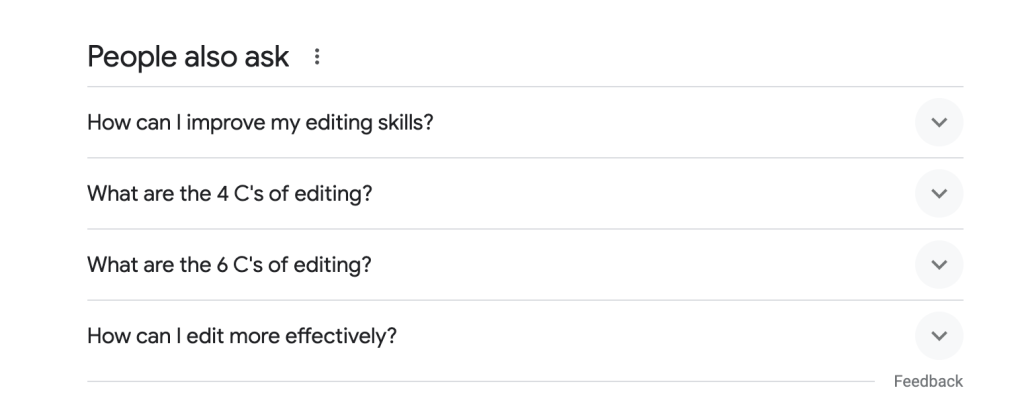
Of course, the People Also Ask questions are a goldmine for determining whether there are other related topics that you may want to address in your post.
2. Delete Unfamiliar Words
You’re an editor, which probably also means you’re a word nerd. If there’s a word you don’t know, others likely don’t know it either. Delete any unfamiliar word unless it’s followed with an explanation. If you must include an unusual word, explain it. Otherwise, replace it with a more common term.
3. Cut Habit Words
All writers have words they use out of habit. Knowing your writers means being aware of their habit words and carving them from their writing. Strong contenders include that, however, regardless, now, currently, and important.
You also may want to check your writing for common grammatical errors that may pop up.
4. Trim the Fat
Even meeting word counts for clients doesn’t give you a license to add a bunch of fluff to your writing. See how many words you can delete before you hit publish. Pretend every word costs $1 and save your money. Concise writing is clear writing. Phrases worth cutting include “in order to” and “in the process of,” although transition words are still important.
5. Write in Time, Date, Place Order
Write everything in time, date, place order. For example, the meeting is at 10 a.m. CST Saturday on Zoom. If the place is a business, always include the address.
Don’t start sentences with days or dates. When it happened is rarely more important than what happened.
6. Avoid Cliches
There’s no place for cliches in your writing. They’re lazy. And they don’t mean the same thing to everyone. Delete cliches and explain what the writer meant to say instead.
The only exception to this rule is when you’re attempting to use cliches to relate to the reader in a more casual way. If this is the case, be certain you’re accomplishing that goal and not inadvertently alienating them.
7. Flip Clauses
Don’t start sentences with long clauses that only delay the action. If a clause requires a comma, move it to the end of the sentence if possible.
8. Avoid Semicolons
Semicolons are for complex or compound sentences. Simple sentences make for the best, most active writing. Break complex or compound sentences into two sentences instead.
9. Edit for Active Voice
Active voice makes writing stronger. The best way to write in an active voice is to use subject-verb-object sentence construction. Think: Who did what? You can make any sentence active if you answer that question in that order.
10. Delete Adverbs
Adverbs are words writers use when they can’t think of strong verbs. Comb sentences for adverbs like “very,” “totally,” or “extremely.” Edit them out and use a strong verb in that place.
11. Save Commas
Don’t throw around commas like they don’t matter. Instead, pretend you only have so many commas to use for the rest of your life. If you run out of commas, you’ll have a life of run-on sentences. If in doubt, edit it out.
12. Use Contractions
Contractions are less formal and help readers feel like they’re talking to you. Instead of “I will go to the play if she is there,” edit the sentence to read,” I’ll go to the play if she’s there.” It’s shorter and more relatable.
13. Pay Attention to Style and Format
We’ve written before about the importance of having a style guide and even provided some advice on creating one. The editing process is when that guide comes into play. The style guide helps you know the client’s individual expectations for tone and word choice. It reminds you how to write and edit their piece to make it uniquely fit their audience.
In addition to the style of writing, you also want to pay close attention to the format. How a blog post is formatted is crucial in whether it’s read.
14. Read It Out Loud
Editors’ eyes get tired. So do their brains. The best thing to do when you’ve made a lot of revisions to a piece or you’re just getting tired for the day is to make that last read verbal. Reading an article out loud can help you make sure it’s clear and correct.
15. Step Away
One of my favorite editing tips is to step away from the writing. When you give it a rest, sometimes you find that the piece is better than you originally thought. You also can look at it through fresh eyes, which helps you see holes in the writing that you hadn’t before or errors that you read over previously.
I really like to be able to leave a piece overnight and come back to it the next day. That isn’t always possible, but you usually do have time to take a break and return to it later.
Let MyMA Edit for You
There are a ton of little ways to improve writing beyond these essential editing tips. The most important thing is that the piece is the best it can be when it reaches the audience.
Don’t want to be a writer or editor or learn to edit? We get it! Not everyone does. Whether you want someone else to write for you or edit your writing, My Marketing Assistant is here to help. Book a call! We’d love the opportunity to help you along your content journey.